Foto at top: Estremadura sun Griffin Vulture size 100cm distance 75m D300 Nikkor 200-500mm f/4.5-5.6E equivalent 750mm substantial camouflage crop 2400 x 1600. Aerodynamic perfection of these mighty wings!
Reach (bereik) is possibly the most important factor in lightweight bird photography although as far as we knowit is nowhere exactly defined. This page and the next one may be a bit hard, but both paged are crucial in lightweight bird photography.
So we tried to develop a method of estimating actual reach (bereik) in the field that worked for us.
(And by the way we more or less accidentally detected one special and exceptionally powerful 1500mm Nikon combination camera-lens-converter. We tend to call it our “Secret Weapon”. If you are seriously interested, send us a message).
What precisely is “reach (bereik)”?
Take a look at these three pictures:
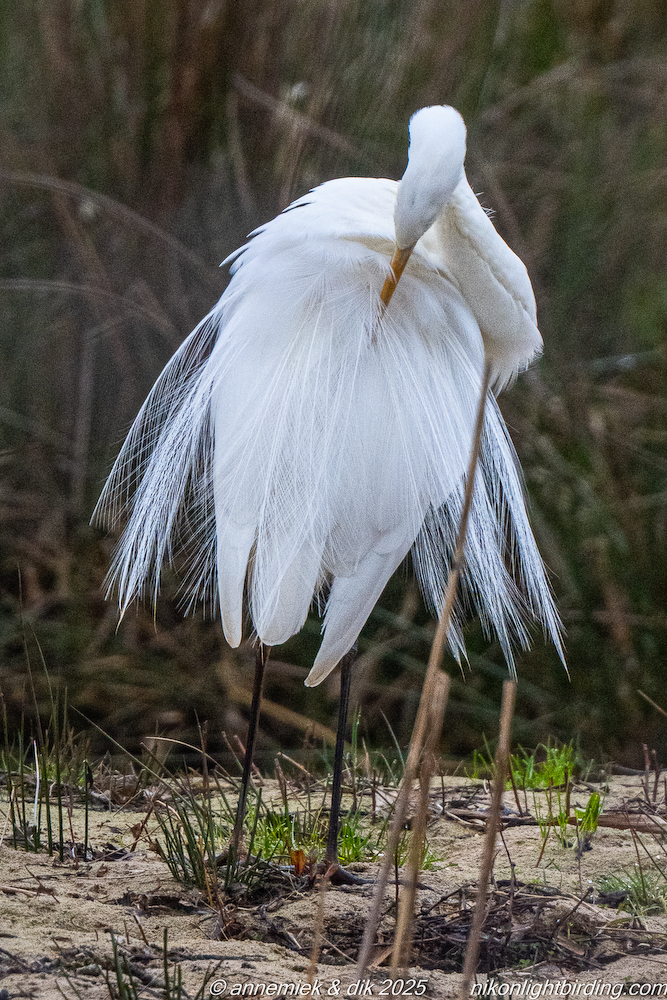
A rather small bird like a Wren (Winterkoning) must be pretty close like 5-25 meter and or your actual photographic equipment must have a rather large 35mm equivalent in order to produce an acceptable detailed picture whereas a Great White Heron (Grote Zilverreiger) can be at 50 meter or even more and still produce a fine picture with that same equipment. Actual reach seems to be dependend of the actual distance camera-bird, the size of the bird being photographed and the 35mm equivalent (definition follows below) of the combination camera- lens-converter and optional stabilization thereof and to a lesser degree on some factors like the actual weather condition and clarity of air as we will see.

(We used our “secret weapon, 35mm equivalent 1500mm” in the next two pictures):

(1) Exact quantification of actual reach (bereik) in bird photography in the field is not always easy although “sufficient reach” is an absolute sine qua non if you want to get sufficiently detailed pictures in your bird photography. Nevertheless: our experience is that, quite often, bird photographers, “experts” or even qualified salesmen of photographic equipment don’t have the foggiest idea what sufficient reach in bird photography really encompasses in terms of choice of equipment, weight, cost, available light and related subjects like camouflage, stabilisation, autofocus speed, etcetera.
(2) Being a serious bird photographer, in the field you do not really always need or use an exact quantification of actual “reach (bereik)”! Rather you need a quick, almost unconscious, estimate of actual reach (bereik) in meters using a given combination-lens-converter, shooting pictures of different bird species at certain distances in varying circumstances of weather and available light.
However you definitely require this estimate every time you got to decide, often in a split second and almost automatically whether or not it makes sense to shoot a picture using your current equipment and the settings thereof … or possibly use other equipment or change your settings or add or remove a converter, if you got the time for this. This typically happens when birds are doing something interesting like mating, fighting, catching a prey and the like and when you got to decide fast and usually you do’nt really need an exact idea but merely a good guess of your chances and sometimes you don’t even have time for guessing: birds don’t wait!
Before we try to define this reach (bereik) we have to define the so called 35mm equivalent of photographic equipment, the base for the overall optical enlargement of any camera-lens-converter combination:
35mm equivalent = focus distance lens in mm x crop factor camera x magnification factor converter.
The magnification factor of Nikon digital converters is usually 1.4 or 1.7 or 2.0.
Examples of crop factors:
- Nikon System 1 camera’s 2.7
- Panasonic system camera G3 2.0.
- Nikon DSLR D500 1.5
- Nikon MLC Z Series Z5, Z50 II 1.5
- Nikon Full frame DSLR D800 1.0
- Nikon MLC Z Series Z7, Z7 II DX mode 1.5
- Nikon MLC Z Series FX mode Z7, Z7 II 1.0.
Examples of calculating 35mm equivalent:
35mm equivalent of combination D300 Nikkor 300mm f/4E PF VR TC-14E = 300 x 1.5 x 1.4 = 630mm.
35mm equivalent of combination MLC Z7 II Nikkor FX mode 500mm f/5.6E PF VR TC-14E = 500 x 1.4 = 700mm.
35mm equivalent of combination DSLR D500 Nikkor 500mm f/5.6E PF VR TC-14E = 500 x 1.5 x 1.4 = 1050mm.
35mm equivalent of combination MLC Z7 II Nikkor DX mode 500mm f/5.6E PF VR TC-14E = 500 x 1.5 x 1.4 = 1050mm.
Definition of reach (bereik) in bird photography
Actual reach (bereik), measured in meters, is equal to the amount of pixels of sufficiently resolved detail per square millimeter of the digital image in a cropped picture of the subject bird using certain photographic equipment with a given 35mm equivalent.
And also: the more you need to crop, the more pixels the bird image in the final total picture should contain and vice versa.
In every situation in he field we try to decide in a split second, more or less automatically, given the size and distance of the bird, etcetera, whether or not our actual level of reach (bereik) will result in sufficient amount of detail in the bird image of the picture. In other words: “Will my current equipment with this 35mm equivalent produce a picture with a sufficiently amount of sufficiently resolved detail in the bird image of the final cropped picture and not undefined small shadow of this bird, yes or no?
Actual Reach (bereik) depends on these factors:
We found that reach (bereik) depends on:
- amount of available light (estimated factor 0-100%: darkness, shadow, heavy overcast, cloudy, light cloudy, sunlight).
- size of bird (“size” in centimeter e.g. in ANWB Bird Guide or other reliable Bird Guide).
- distance camera-bird.
- 35mm equivalent in mm (focus distance of used camera-lens-converter x crop factors camera)).
- resolution sensor in Megapixel/square millimeter.
- quality atmosphere: clean air, hazy, dense fog, cloudy, heavy overcast, clear air). We never apply this factor in standard bird photography because it usually does not significantly affect reach (bereik), rather color contrast and clarity picture.
In this blog we always explicitly mention with every picture: size of bird, distance to bird and 35 mm equivalent used.
When we want to quantify reach (bereik) we will need some kind of measure (maatstaf). We will use the following picture of a Kingfisher (IJsvogel) as our measure for reach (bereik):
This picture of a Kingfisher (IJsvogel) at distance 25m, sunlight, using Nikon Z50 Nikkor 500mm f/5.6E PF VR, 35mm equivalent 1500mm is our benchmark (maatstaf) for what we consider to be “sufficiently resolved” in our bird photography.
By our definition this picture contains a sufficient amount of sufficiently resolved detail of the subject bird.

“Height” bird image head-through-tail in this benchmark picture is about 50% of the total height of this benchmark picture.
Because we are using this benchmark picture over and over again in our bird photography we have chosen an average sized bird at an average distance using high quality photographic equipment with a more or less standard 35mm equivalent and not some large or small bird, close by or far away and we did apply an average amount of cropping in such a way that the cropped image of the bird is about 50% of the total height of the picture. This facilitates estimating reach (bereik) of other birds in similar or different situations in the field as we will see.
You yourself can of course define any other picture as being your benchmark picture of what you consider “sufficiently resolved“, etcetera. But anyway do not use an extremely rare, small or large bird, close by or far away nor a flying or moving bird. Be aware that you will use this picture frequently in the back of your mind when you are estimating actual reach (bereik) in the field during actual photography.
We show and review examples of estimating reach (bereik) at Estimating reach.
Workshop Lightweight bird photography:
- WS1 Reach (bereik)
- WS2 Estimating reach
- WS3 “Big Three”: APERTURE, ISO, EXPOSURE time
- WS4 APERTURE
- WS5 ISO
- WS6 EXPOSURE TIME
…

Pingback: WS4 APERTURE – nikonlightbirding
Pingback: WS5 ISO – nikonlightbirding
Pingback: ACTION – nikonlightbirding
Pingback: HOME – nikonlightbirding
Pingback: txt home page – nikonlightbirding
Pingback: WS 3 APERTURE, ISO, EXPOSURE TIME – nikonlightbirding