Photo at top: Holland, dark rainy wheather, Little Owl (Steenuil), size 22cm, dist. 35m, taking rain bath, eq. 1260mm.
F11: full screen
Why this special APERTURE Mode Birds?
APERTURE Mode Birds is not something brilliant or some clever photographing technique. It is an effective combination of settings of our Nikon camera of the day, usually D500, Z50 or Z7 II and – this is key! – our beloved Nikon optical equipment, those fantastic Phase Fresnel Nikkors and top quality converters providing us with up to 1500mm 35mm equivalent and a handful of common photographing techniques. We optimized and tested our “Aperture Mode Birds” during several years of serious bird photography with lightweight Nikon photographic equipment. Using APERTURE Mode Birds you can during actual photography spend 90% of your time and attention at the birds, their behaviour and often quite unexpected activities in stead of frequently changing camera settings. Take a look at these three pictures:
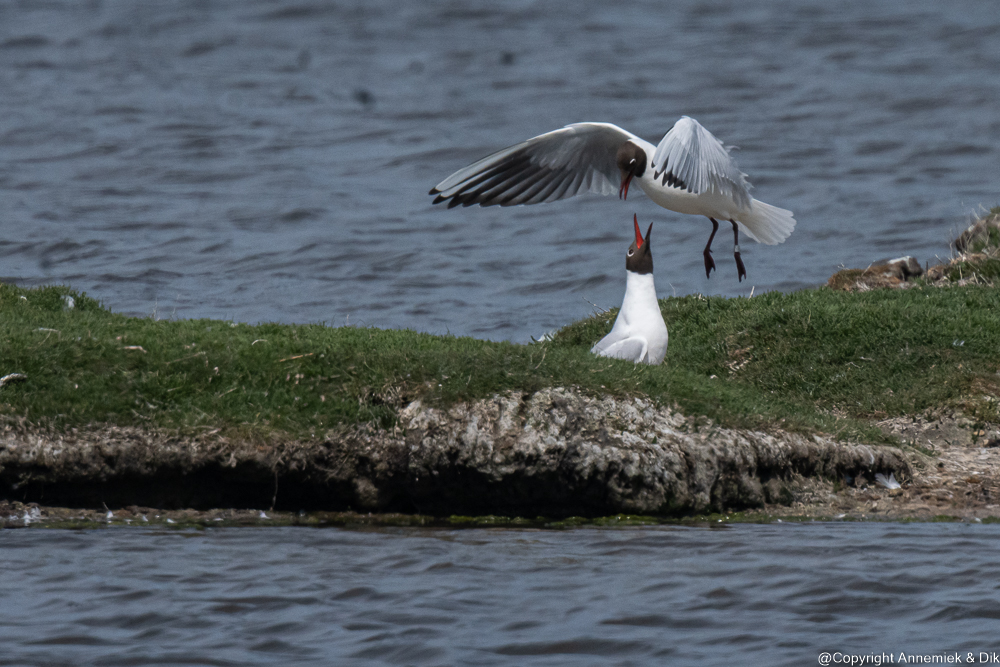
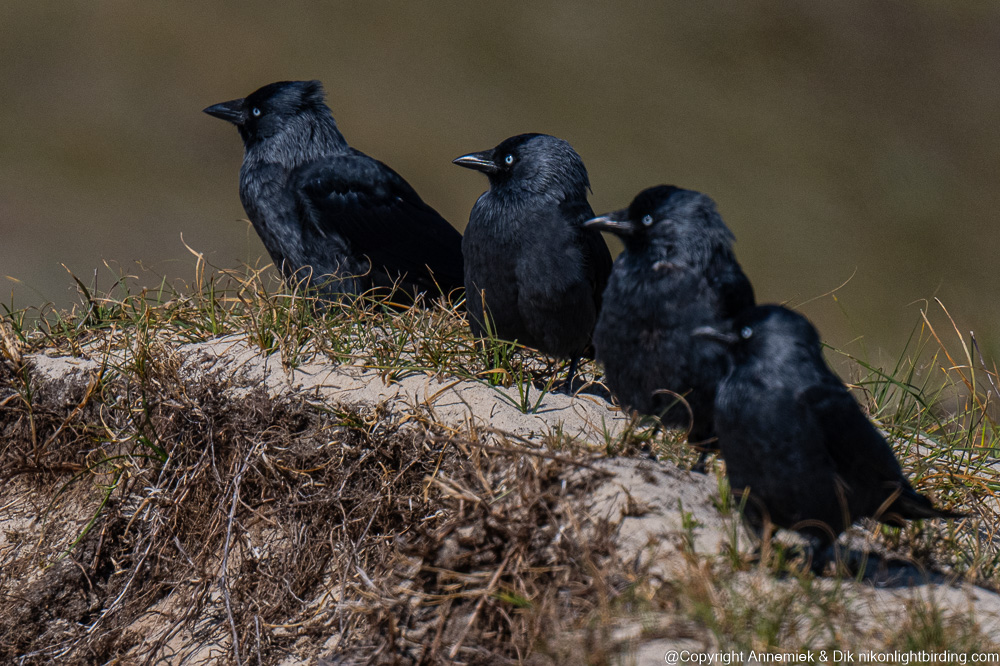
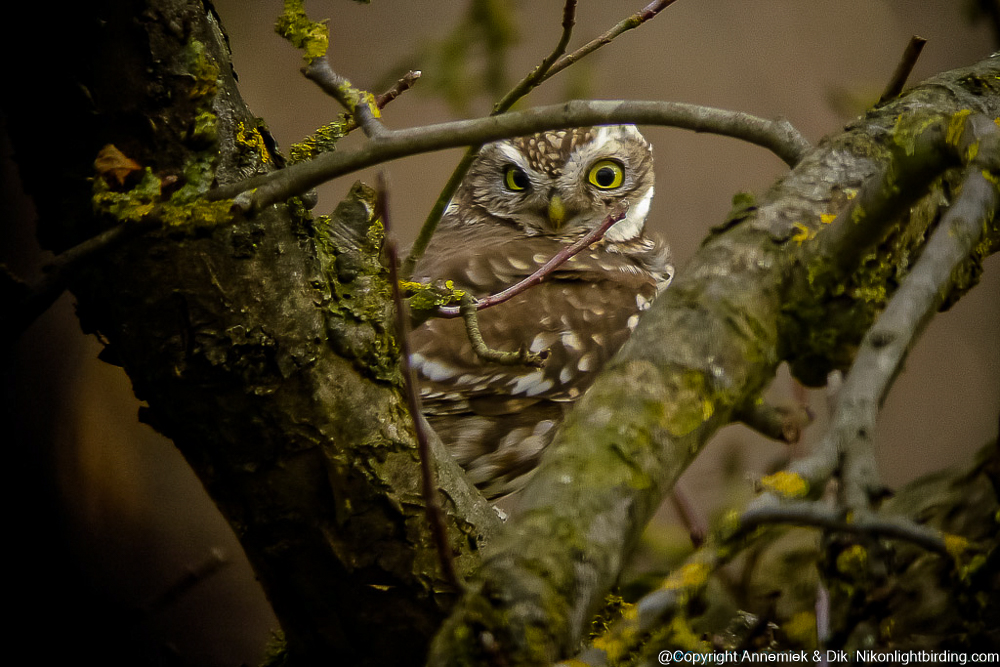
The black-headed Gull above the nest will soon fly away. One or more of the Jackdaws may leave in a while and the Little Owl will not continue staring at you but soon look at something more interesting. These pictures illustrate the fact that, during actual bird photography, you often have only seconds to optimize camera settings and get good pictures. Lightweight bird photography is more difficult than one may realize. It requires good knowledge of birds, their breeding, feeding and migrating habits and their “specific” behaviour, species after species after species, at home, abroad, spring, winter, summer, in autumn and winterYou also need sufficient photographing skills, fast reactions and top quality photographic equipment: camera’s, lenses, converters, binoculars, tripod and or rice bag, spare batteries, memory cards, lens cleaning pad, camouflage, good light and a bit of luck. However, during actual photography, you may find yourself almost continuously optimising your camera settings in order to deal with either:
- small birds far away requiring maximal detail and preferably MINIMAL ISO value
- bird action requiring SHORT EXPOSURE TIME and consequently HIGH ISO value
- sudden changes from LARGE BIRDS CLOSE BY to SMALL BIRDS FAR AWAY or vice versa, forcing you to CHANGE LENSES and or CONVERTERS faster than you can manage or use zoom lenses with inhaerent lower quality.
On top of this weather and or amount and or direction of available light can change during the day if for example the sun suddenly disappears behind a cloud or the wheataher changes, forcing you to change camera settings or lenses or converters. Also from time to time you may like to switch your full frame camera from FX mode to DX mode or vice versa in order to change your perspective or acquire pictures panorama or close up type. In practice you may find yourself, during actual photography, almost continuously checking and resetting values of APERTURE, ISO and EXPOSURE Time (Compensation) and changing lenses and converters, whereas in fact, during actual bird photography, you would prefer to:
- use constant large value of APERTURE, getting all the light you can get,
- use short EXPOSURE TIME, being ready for fast bird action,
- only by exception change values of ISO sensitivity or other things.
- permanently focus at the birds and their activities and be ready to shoot pictures when something interesting happens…

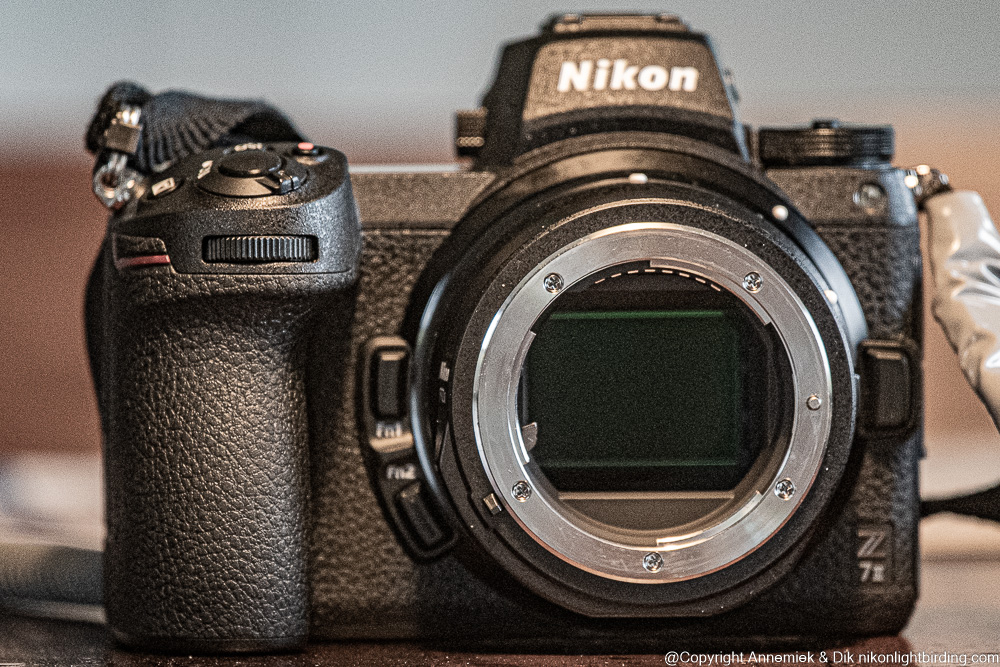
So, If you keep APERTURE value constant and keep EXPOSURE TIME more or less permanently low, only ISO value can be changed so then automatically the question arises: “Can’t I eliminate all this continuous checking & resetting of ISO value and let my clever camera do the thinking and ISO resetting so that I myself can relax and enjoy my birding and photography instead of spending all my time at this dreadful check & reset?” Anyway and with some trial and error we developed our “APERTURE Mode Birds” which proved to be a surprisingly effective, comfortable and reliable combination of standard APERTURE mode, Easy EXPOSURE Compensation, Back Button Autofocus, systematic underexposure, Automatic ISO Sensitivity setting and “Focus and recompose“. These techniques, together, proved to fit perfectly into “APERTURE Mode Birds, thanks to the programmability of Nikon’s D500, Z50, Z7 II. This “APERTURE Mode Birds” automatizes all other camera settings and does the trick. It works, every time again, years already! (One can probably program similar camera’s of Canon, Fujifilm, Leica, Sony and other top quality brands in the same way, although Nikons mirrorless camera’s may always may have this essential advantage of their exceptionally large light transmission-opening (light from lens onto image sensor)). And by the way: we almost never any more stop down modern Nikkor lenses in bird photography. The camera gets all available light for reliable autofocus also in low light-conditions.
Some notes regarding Maximal ISO value
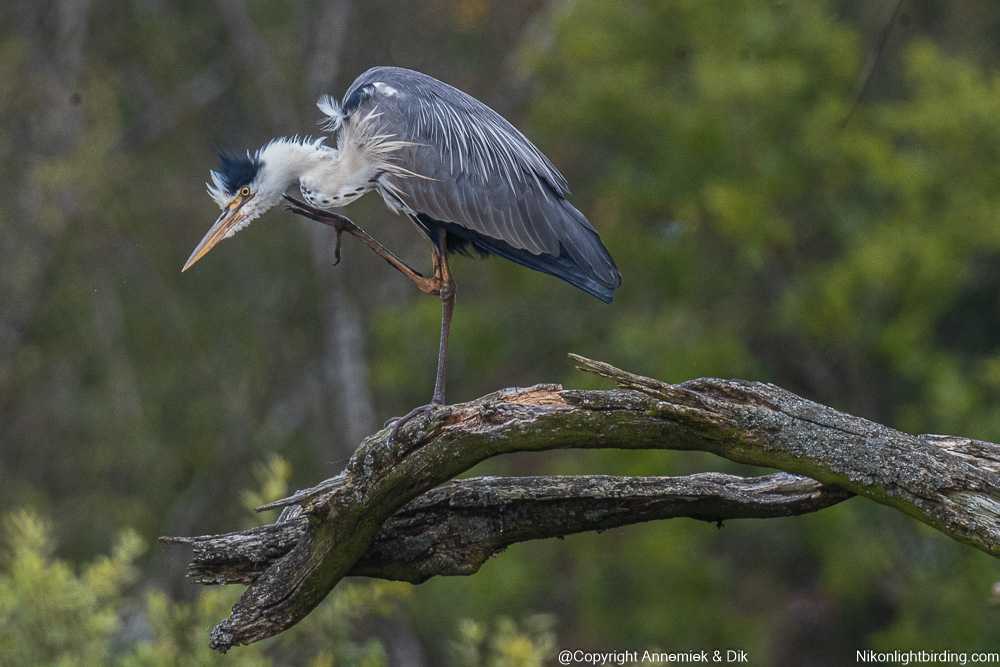
By default – in bird photography – ISO value 6.400 is our personal upper limit, preferably even 3.200. Nevertheless: late Nikon DSLR‘s and Z Series MLC’s produce quite acceptable bird pictures at far more high ISO values, even up to ISO 12.800. You may judge otherwise but it is worthwhile experimenting at higher ISO values, particularly with fast moving birds. Take a look at some examples of relatively high ISO values below and at page ISO.

You can find pertinent camera settings for “APERTURE Mode Birds” at Settings A Mode Birds D500 or Settings Z50 A Mode Birds or Settings A Mode Birds Z7 II.
The general idea when using APERTURE Mode Birds is: pick up your camera anytime and thereafter:
- Focus at bird(s). Do not waste time composing, but focus and shoot in-focus picture(s)!
- (Re)compose if you got time or when shooting stills, landscape, no action or the like.
- Press Release button.
Note: (below: for “AF-ON” read: “AF-ON” (D500 or Z7 II) or “AF-L/AE-L” (Z50):
- Ensure lens is wide open; maximal APERTURE value. (Do Not Forget This!).
- Press OK button to ensure AF point is in centre viewfinder. (Do Not Forget This!).
- Point your camera at the bird(s).
- Full press and hold AF-ON (back button focus): camera will perform autofocus in the way you have set it, for example AF Continuous d72 at D500 or AF-C AF-area Wide at Z50, and will continue focussing when you move camera, either because you want to follow bird(s) activity or to recompose the picture. Your camera will also continuously feed back remaining space image buffer as long as you keep pressing Release.
- Press Release every time you want to make a (series of) picture(s).
- Occasionally, if you got the time and if you wish, stop pressing AF-ON and check actual ISO value. Camera will show this any time and as long as you do not press AF-ON.
- Otherwise continue/resume pressing AF-ON as long as you want camera to continue focus & track. Full press Release any time you want to shoot one or more picture(s) at actual distance. Do not press Release when the camera is not actually focused at the bird(s) because camera will then loose its last focus distance completely and may even start hunting! So do NOT touch Release button unless you are assured that camera is focused! Practice this. It is important!
- Do not switch camera OFF as long as you are in the field. It will enter standby mode after 1 minute (if you have set it that way). Preferably leave camera in standby mode all day when you are out photographing and want to be prepared for anything unexpected. If something interesting shows up, camera will be re ready right away.
This way the camera will continue focusing & tracking every time you pick it up and as long as you press AF-On button until you stop shooting or card is full or battery is empty or you switch camera off.
Only by exception and very occasionally you may have to adjust EXPOSURE TIME via subdial (now set as your EXPOSURE TIME compensation +/- button), and only if amount or direction of light changes significantly. Even if you have no time to do this your Nikon will usually still produce acceptable, for example in Adobe Lightroom, correctable pictures.
In this way you can control, via subdial, EXPOSURE TIME, easily counting in half stops (if you have set it this way). Even if you have no time to reset this, you will get acceptable pictures, anyway never blurred pictures or pictures with unnecessary high ISO values and noise. The camera will be able to handle almost any situation. The room for EXPOSURE compensation in modern Nikon digital camera’s is about 5 stops: +/- 2.5 stops. Try it out, you will but occasionally have to use the subdial and change the amout of UNDER EXPOSURE when the situation changes drastically, like when:
- (Expected) species, activity or speed (flying or moving) of birds change completely.
- Sunlight (re-)appears after clouds have drifted away or vice versa.
- Your bird moves from deep shadow to direct sunlight or vice versa.
- You have to redirect camera from backlight to front light or vice versa.
Every time suddenly something interesting happens around you, you can pick up the camera and press Release. It will do what you have set it to do…
More about Automatic ISO Sensitivity control
Make sure you do understand this correctly: Your “clever” D500, Z50 or Z7 II or other modern Nikon camera will try to keep EXPOSURE TIME between the limits you have set for Minimal Shutterspeed and Maximum ISO Sensitivity and, if this happens to be impossible, suggest and use shutterspeed lower than the value set by you. For example requiring a Minimum Shutterspeed 1/1000 in combination with Maximum ISO 6400 effectively means: set EXPOSURE Time to 1/1000 second or shorter (like 1/1500 second or even shorter) and try to keep ISO Sensitivity below 6400. If this is impossible, for example when you get insufficient available light, the camera will – in our experience – prioritize high shutterspeed over low ISO values and for example actually use EXPOSURE Time 1/1000 and ISO Sensitivity 9000 or something the like. We think this really makes sense in bird photography: more noise and some loss in color contrast is not as bad as possibly too low shutterspeed and subsequently worthless blurred pictures.
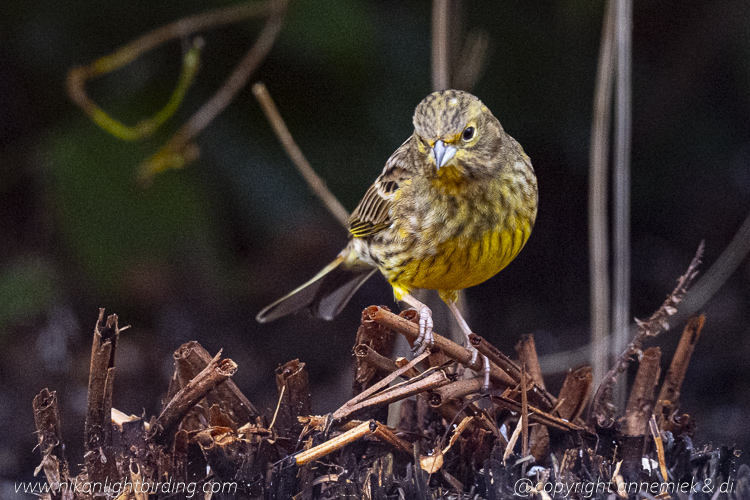
In this context: recenty february 2026 we observed that Nikon had rather substantially improved the signal-noise ratio of late Z7 II image sensor and we could acquirw quite acceptable pictures up to values like 180.000 ISO. Look at the picture of the Yellowhammer (man Geelgors) in rather dark wheather below for example. So we moved our maximum ISO value APERTURE Mode Birds from 6.400 ISO to 180.000 ISO which implies an upgrade of about two stops, mind you! (not yet tested at D500).
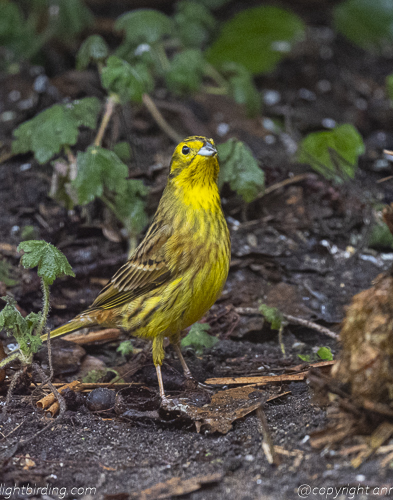
Another one of the same bird in bright sunlight:
Try all this out for a while and change Maximal ISO and Minimal Shutterspeed values camera according to your personal guidelines of image quality and or (expected) weather and or type and speed of birds. Check the results to gain experience in setting those limits. Our experience – several years by now – is, that this A Mode Birds method really works fine. It is extremely comfortable and absolutely reliable in lightweight bird (and general nature) photography, but it takes a bit of time to get the right feel for it. Grant it that time and you will eventually save lots of time.
Using APERTURE Mode Birds you may also notice:
The D500 will keep the optical image in the optical viewer stable, with the advantage that you can better observe, follow and anticipate bird action and redirect your camera accordingly. We tend to use D500 for fast action photography like shooting Woodpeckers (Spechten) and Terns (Sterns) and Z50 or Z7 II for other bird photography, also because we can use our top quality lightweight Nikkor 300mm f/4E PF VR or beloved favorite Nikkor 500mm f/5.6E PF VR giving us a luxurious 1500mm 35mm equivalent with almost no loss in image quality. And once more: it all this is not particularly cheap but wonderful lightweight equipment!
The frame rate may drop somewhat. In our experience D500 drops from 11 FPS to an average of 8 FPS and the Z50 goes from 10 FPS to sometimes 7 FPS. This is not as bad as it sounds: all pictures are de facto in-focus because of your a1-setting. In other words: you are missing blurred pictures only.
So why does this work so well?
Why do you consistently get in-focus pictures and sometimes even surprisingly attractive pictures also when your birds are moving or acting at high speed and your photography feels like you are using a simple “point and shoot camera when using this APERTURE Mode Birds“? This is why:
- You have streamlined your photography via back button autofocus using AF-ON button to focus camera and independently press Release anytime you wish to shoot (a series of) picture(s) using forefinger & thumb only.
- You now comfortably use Easy EXPOSURE TIME Compensation +/- with thumb on the large back wheel of the camera and you keep one hand free for handling or redirecting tripod, camera or lens. In fact you have “dahboard” of your camera in such a way that you now always use the left button on top of the camera for reviewing you pictures and your right hand only for controlling, in a safe and easy way via back wheel, the exact amount of light the image sensor will receive.
- You are committed to RAW workflow using professional image editing software for example Lightroom.
- Either: your mirrorless camera Z50 or Z7 II or other Z camera is set to focus and track fast flying birds in APERTURE Mode with always maximal APERTURE value.
- Or: D500 or other is optimized for accurate focus and track via dynamic anticipating mode using 25 or 72 AF points.
- Your camera is optimized for accurate focus and track in AF-C wide AF area (L) and either way you can continuously focus and track bird(s) and recompose at wish.
- The camera uses Automatic ISO sensitivity control via a lightning fast processor and you have put your personal preference in bird photography concerning ISO sensitivity and shutterspeed into its memory.
- As a result camera gathers maximum amount of light during optimal EXPOSURE TIME to produce in-focus, detailed pictures according to your preference of optimal EXPOSURE TIME and ISO in bird photography.The camera shoots your pictures of birds and other life. During photography you can dedicate all your time to enjoy nature, birds and other wildlife, anticipate action and press Release at right moments, in stead of continuously resetting ISO, EXPOSURE Time, etc.
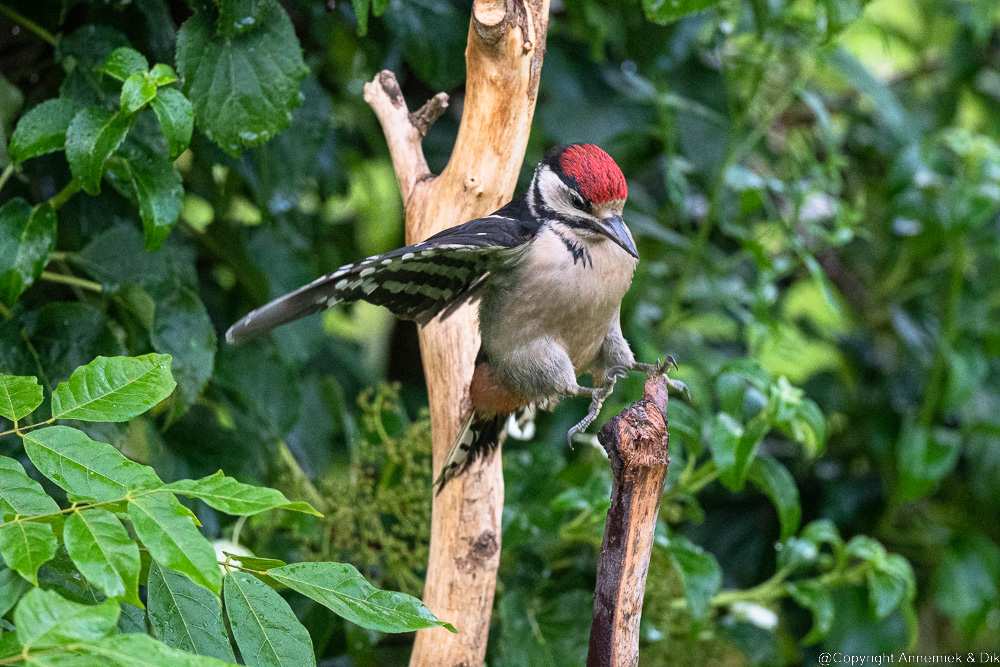
You now shoot pictures like the action below (notice optimal trade off EXPOSURE TIME 1/1250 second and ISO value 4000):
Examples using APERTURE Mode Birds




…
