Photo at top: Holland sun windy Kingfisher (IJsvogel) female, repairing nest corridor, size 20cm distance 35m, Z50 Nikkor 500mm f/5.6E PF VR equivalent 1500mm total camouflage. Notice cobweb spider at branch left of bird: splendid detail!
F11: full screen
Three photographing techniques and three camera settings
Three photographing techniques plus three camera settings will transform your bird photography into something far more easy, comfortable and succesful:
- “Back button autofocus”: completely separate camera funtions autofocus and shutter release.
- “Focus and recompose“: focus, hold focus & redirect camera if necessary, shoot the picture you want.
- “Underexposure” systematically 0.5 – 2.0 EV: protect detail in the Highlights picture.
- Camera setting Automatic ISO sensitivity control: minimal ISO value within” max. ISO & min”. shutterspeed.
- Camera setting Automatic Whitebalance (correct whitebalance in post production (if at all required).
- Camera setting Automatic shutdown: save battery power during unexpected long session(s), pick up your camera again whenever you want, press Release and resume photographing.
Photographing birds in “APERTURE mode Birds” is quite comfortable and very easy! You can dedicate almost all your attention at the birds and but occasionally may need to reset one or two parameters like Minimal ISO or Maximal Shutterspeed when wheather or type of birds change substantially.
Our special APERTURE mode Birds really works! We have been using it for several years now …
Example technique “focus and recompose”:
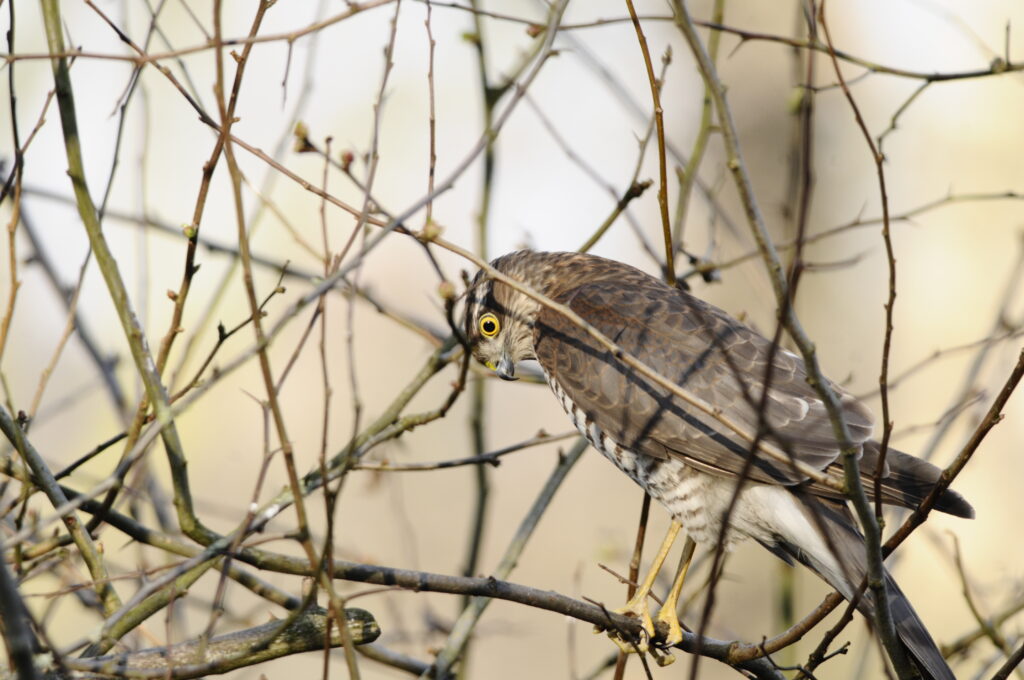
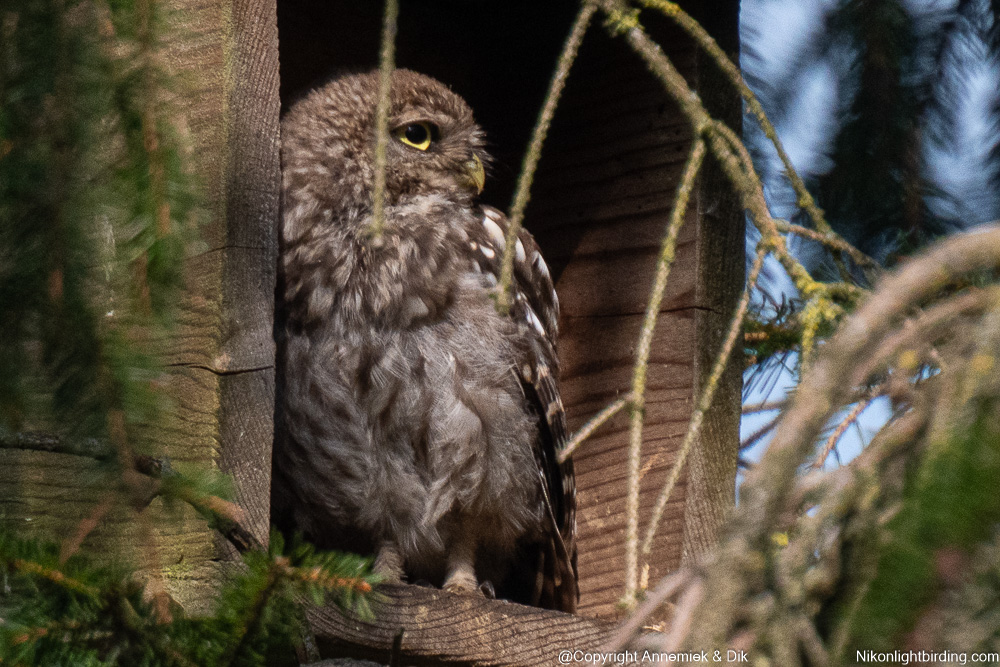
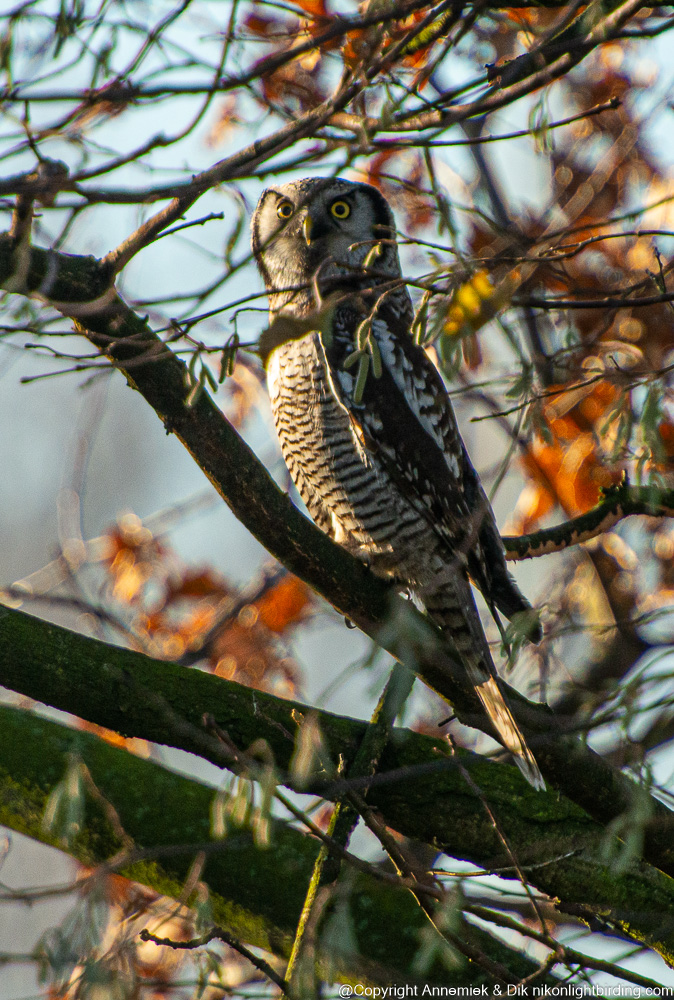
@dik example FAR
Focussing in APERTURE mode Birds *)
When using Nikon DSLR (or any other Nikon DSLR): know the optimal setting of a9 by heart and (re)set camera, only when required during actual photography, in advanced AF mode like this:
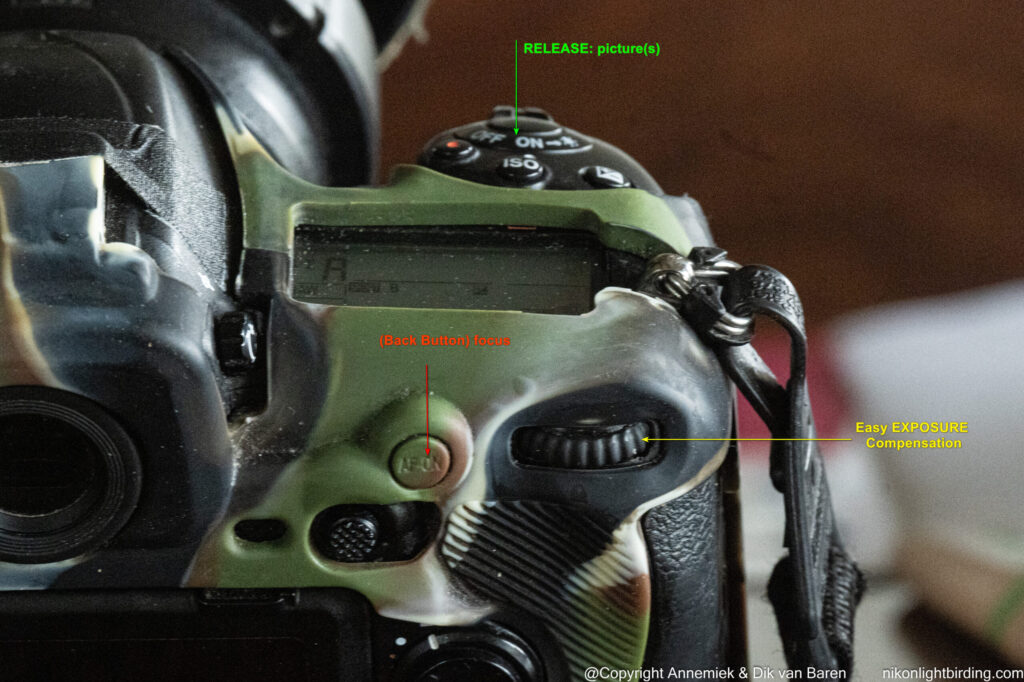
a9 = limit AF options: restrict D500 to 2 options out of 7 like: Single point and GRP out of in total sevenve possilities, Single point, dynamic 25 points, dynamic 72 points, dynamic 153 points, 3-D, GROUP and auto AF. This results in using in total maximally three different combinations of Nikon equipment Single point, GRP and qqq.
At present we are using our favourites D500, Z50, Z7 II, Nikkor 300mm f/5.6E PF VR and Nikkor 500mm f/4E PF VR, TC-14E II or III and aspherical TC-20E III.
When using a Nikon mirrorless Z camera: know the following setting by heart and (re)set camera, when required during actual photography, in advanced AF mode like this:
- AF-mode: AF-S pinpoint
- AF-area: AF-C wide area
(Example picture Z50 on top of this page).
*) If you are using other (semi) professional equipment like Canon, Fujifilm, Leica, Panasonic or Sony you have to work out the equivalent equipment and settings. The principles of lightweight potography and possibly some variation of the pertinent APERTURE mode remain the same.
*) We chose Nikon equipment and review our bird photography exclusively using Nikon lightweight equipment since we are convinced sure this is, for us, the best choice, More about this at Why Nikon? Using any other equipment, may also offer a sound solution in bird photoraphy. Feel free to apply the ideas presented in this blog using any other brand. The idea behind our “lighweight bird photography” are more or less universal. We have been enjoying bird photography using Nikon equipment for over 40 years now. Nikon EL2 was our first DSLR ever. At present our favourites are Nikon D500, Z50, Z7 II, Nikkor 300mm f/5.6E PF VR, 500mm f/4E PF VR, TC-14E II or III and aspherical TC-20E III.
Actually using APERTURE Mode Birds
If you set you camera and choose your equipment accordingly, in other words when using these standard pphotographing techniques, the right equipment and settings thereof, you can handle your Nikon DSLR or MLC as follows:
Z50: You only use three camera buttons during actual bird photography like this:
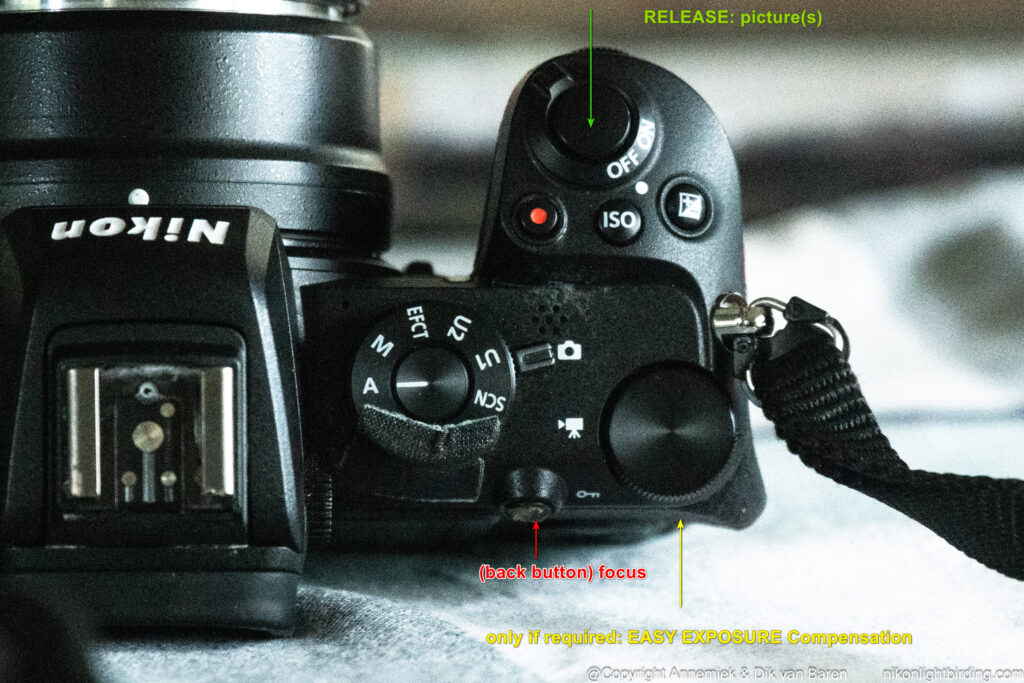
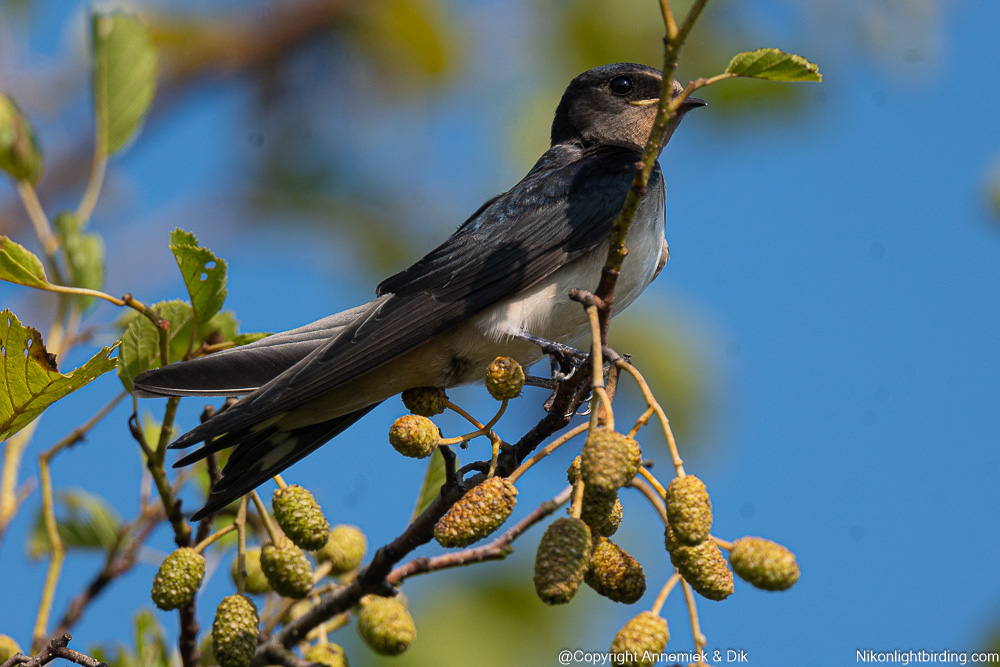
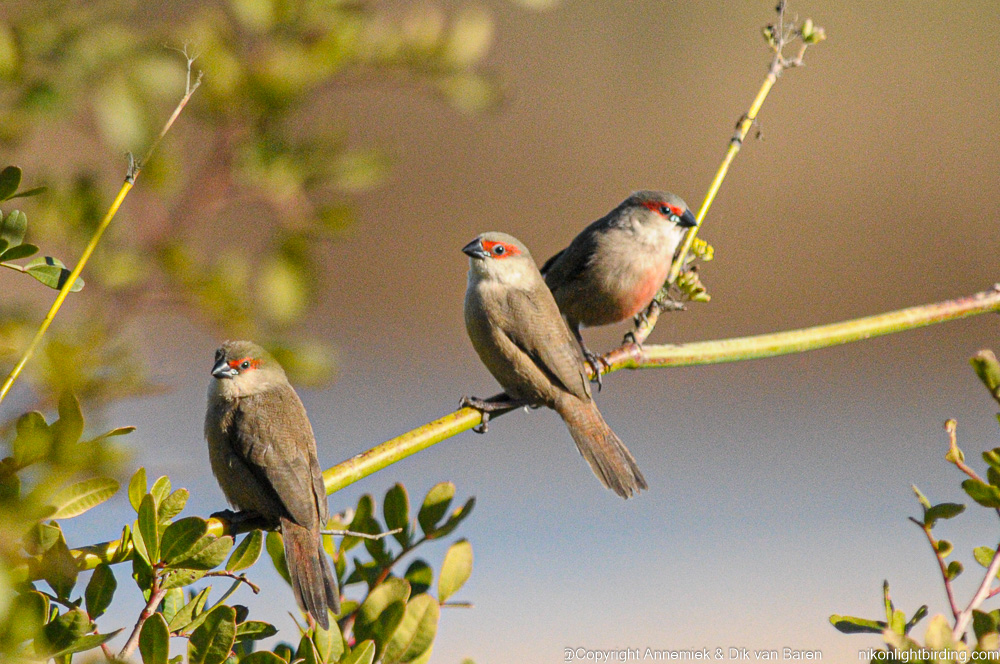
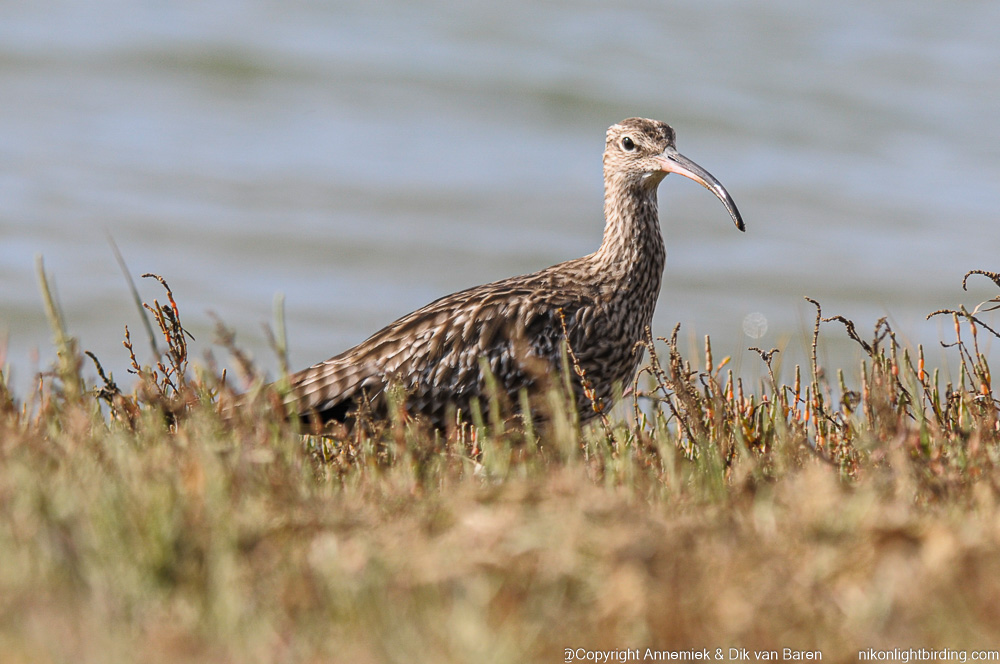
Examples using Focus and Recompose, Back Button Autofocus and Structural Underexpose in APERTURE Mode Birds: