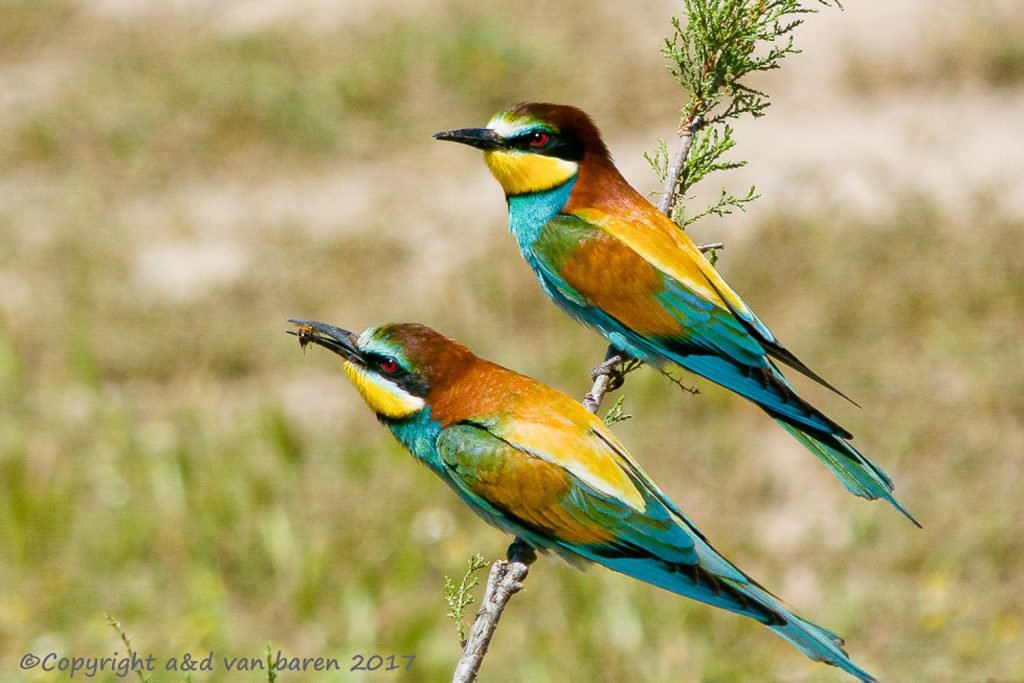
Photo at top: Lesbos Mediterranean Sea and some hills at the overside of south bay. Nikon DSLR D300 Nikkor 50mm f/1.4 35mm equivalent: 50 x 1.5 = 75mm. At the bottom of this page you see a picture of Bee Eaters at Lesbos at a distance of about 20 meter, taken with Nikon mirrorless camera V1 nikkor 18.1mm f/1.8 + Swarovski telescope 35mm equivalent: 2.7 x 18.1 x 50 = 2500mm. Those two pictures illustrate the enormous difference in reach (bereik) and perspective of essentially different optical combinations.
F11: Full screen !!!
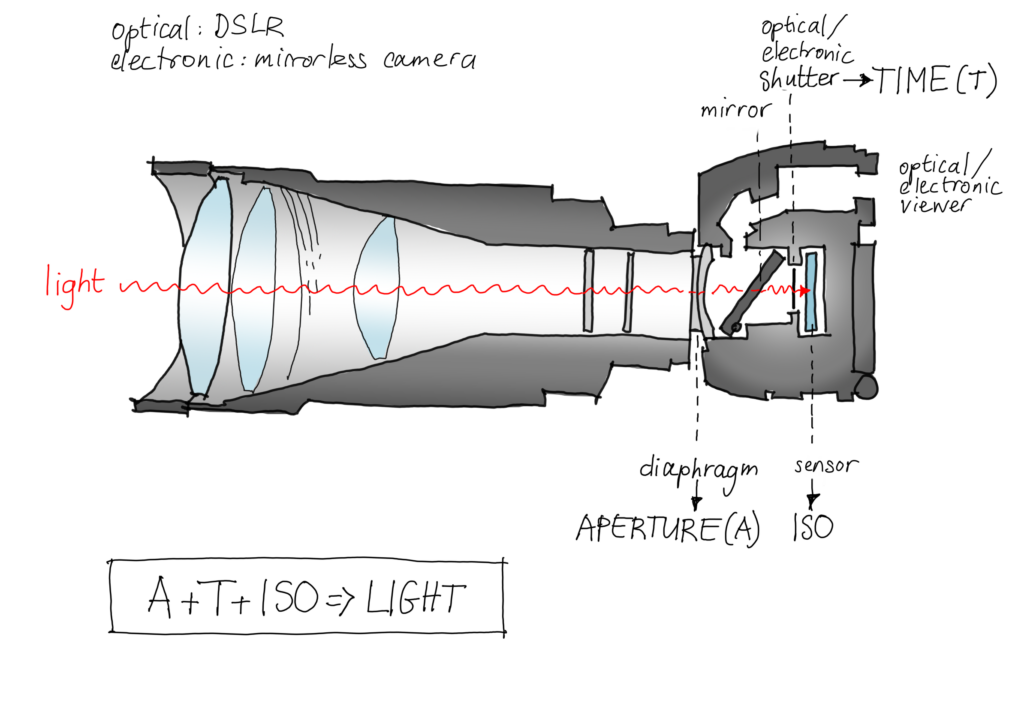
The total amount of light received by the image sensor is determine by (1) opening diaphragm APERTURE A, (2) EXPOSURE TIME T and (3) light sensitivity image sensor: ISO value.
DSLR or mirrorless?
A “DSLR” is a system camera (interchangable lenses) using a mirror and pentaprisma for its optical viewfinder (zoeker) and a mechanical shutter. It uses an image sensor but also a separate autofocus sensor. Nikon DSLR’s use “F-mount“ (F-bajonet) lenses. Canon DSLR’s use their “E-mount” lenses, etcetera. Nikon Z camera’s can also use F-mount lenses in combination with an optical adapter, called FTZ adapter or late FTZ II adapter.
An “MLC” is a MirrorLess system Camera (interchangable lenses) and does not need a mirror and prisma but uses a high resolution Electronic Viewfinder “EVF” (electronische zoeker) replacing mirror, pentaprisma and optical viewfinder. Once you get used to the clear viewer (like using Z50 or Z7 II) it is hard to switch back to the “restricted” optical viewfinder of a DSLR. The EVF of an MLC is a significant improvement in bird photography, not only when working in low light situations but particularly in clear sunlight because one can far better check picture quality via the bright highres EVF.
Market leading producers like Canon, Sony, Fujifilm, Nikon, Leica and Panasonic are moving away from the DSLR concept and (almost) exclusively investing in extending their product line of MLC’s and compatible lenses. For example Nikons S class Z Mount lenses are side by side lighter and optically superior to their F Mount counterparts. A typical example is the Z mount Nikkor 800mm flagship announced 2023 as being “Lighter and cheaper” than its F mount nephew.
The autofocus function of an MLC is integrated in the one and only sensor in the camera. MLC’s electronic shutter enable the camera to produce pictures at exceptionally high burst rates, only limited by (electronical) data bus speed, data buffer size and card speed. An MLC is usually smaller and lighter than a DSLR but has comparable or even superior ergonomics, functionality and quality. It uses relatively lighter lenses of significantly higher optical quality like the superior S class lenses of Nikons Z MLC’s. They feature a relatively larger Z-mount (Z-lensvatting) which covers a ssignificantly greater or even entire image sensor surface for light transmission, than classical F-mount camera’s and lenses do.
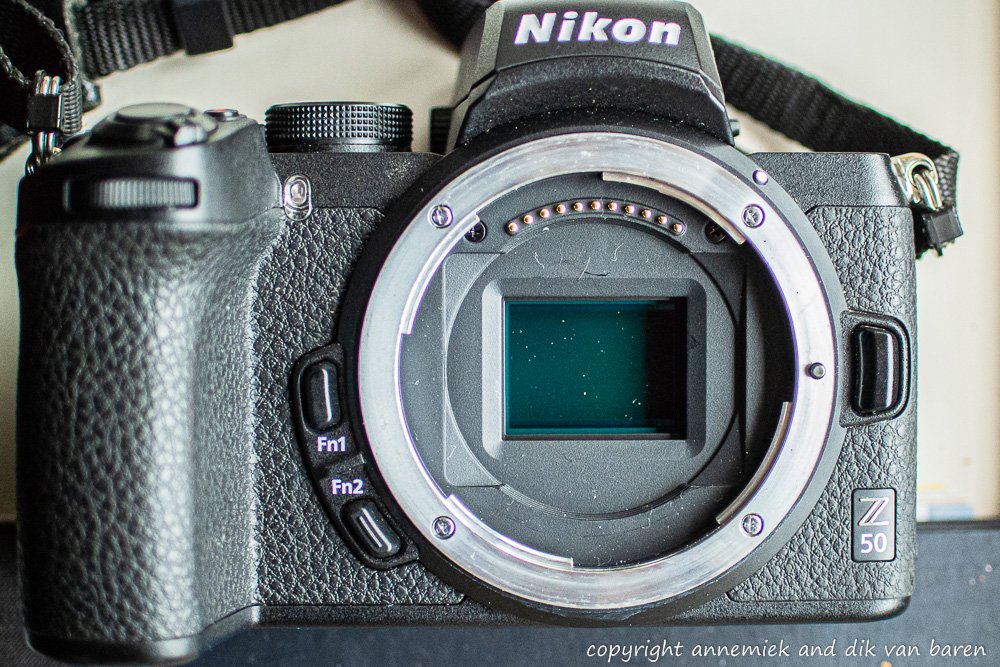
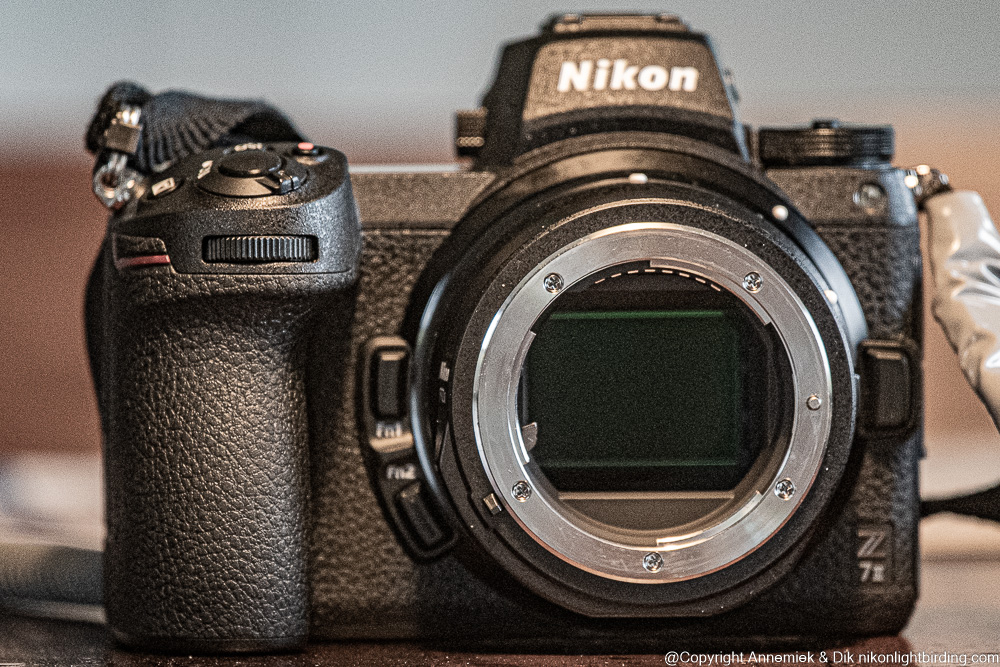
DSLR’s and MLC’s, are system camera’s (systeemcamera’s). You can interchange and mount lenses as long as they use a compatible lens mount (lensvatting), ikon uses their F-mount lenses on DSLR’s, CX-mount on System 1 MLC’s and Z-mount lenses on Z series MLC‘s. By the way Sigma and Tamron produce high quallity CX-mount and Z-mount compatible (zoom)lenses.
Lens mounts (lensvattingen) are very important. The diameter of their opening determines the amount of light transmitted onto the sensor. Mount adapter FTZ (F mount To System Z) or FTZ II, next to transferring light, also pass on electronic control signals for APERTURE, autofocus and stabilisation of the lens. Canon uses its “E-mount“, Panasonics four thirds MLC’s like in their G3, a great MLC and popular amongst digiscopers, the other “digiscoping champion” being Nikons System 1 V1. Sony uses yet another mount, etcetera. Numerous adapters exist to interchange lenses in between camera brands.
Reach (bereik) camera’s
Reach (bereik) is key in bird photography. Some facts about Nikon camera’s and converters are important:
- An APS-C type image sensor with an image area (beeldoppervlak) 24 x 16 mm is significantly smaller than a full frame sensor with 36 x 24 mm surface. This results in a so called crop factor 1.5 which contributes substantially to larger reach (bereik) of Z50 and late Z50 II. Detailed explanation at: 6 Reach.
- The usage of converters has traditional been a trade off in bird photography because it may decrease image quality. However high quality converters in combination with high quality lenses like Nikkor 300mm f/4D, Nikkor 300mm f/4E PF VR, Nikkor 500mm f/5.6E PF VR and Nikon Z System S-class tele lenses (and some other Z lenses) have changed this significantly.
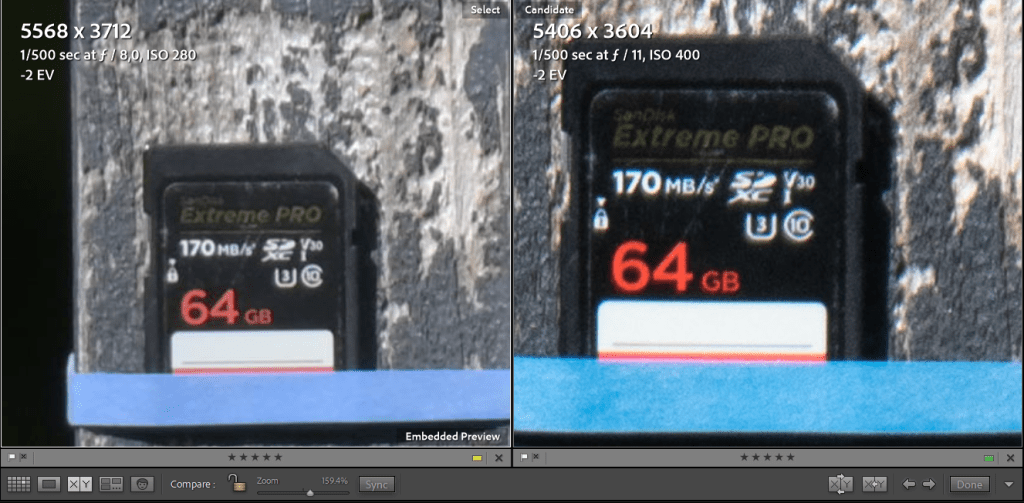
- In our experience particularly aspherical converter TC-20E III in combination with Z mount lenses gives us substantial reach (bereik) up to 1500mm equivalent maintaining high image quality. Particularly in combination with ultralight Fresnel-lenses, Nikkor 300mm f/4E PF VR (770 gram) and NIkkor 500mm PF VR f/5.6E PF VR (1450 gram), we do appreciate this converter. See the testfoto SD card at 28 meter below. We found that this appreciation is shared by many bird photographers.
- Nikon System 1 Series and Z camera’s, support the use of Nikon’s aspherical converter TC-20E III in combination with F mount (compatible) Nikkor lenses. This is a advantage next to the obvious benefit of an high resolution EVF providing us in the field with perfect instant review of pictures made in dark wheather or bright sunlight.
- Nikon claims that the resolution of Nikkor 500mm PF VR f/5.6E PF VR will not degrade when using converter TC-14E type III. In our experience this is true. Anyway we are regarding this Nikkor 500mm PF VR f/5.6E PF VR more or less as our “poor man’s 700mm f/8 super telelens” (with built-out converter).
Two important “Nikon facts”
Nikon Z Camera’s have the largest light transmission opening in this mirrorless class!
Nikkor aspherical converter TC-20E III with Z mount lenses gives reach (bereik) up to 1500mm equivalent maintaining satisfactory image quality with Phase Fresnel Nikkors 300mm and 500mm.
More about Z50
Affordable APS-C type MLC with good grip, also with F-mount lenses. High resolution electronic viewfinder “EVF” extraordinary useful in good light and low light circumstances. Speed 9 FPS, data buffer qqq. Two card slots. High quality pictures ISO range 100 – 51.200. Based on an improved D500 image sensor with autofocus function integrated at the sensor.
We are experiencing two problems: No Multiselector Lock switch like at D500, so from time to time you have to press OK button to reposition AF selector in the centre of the image viewer. Also somewhat restricted AF and AF subject tracking. Anyway this Z50 is a great camera in lightweight bird photography. We have been using it for several years now.
This Z50 has rightfully received an EISA award for its high price/performance-ratio.
More about Z7 II
Fast reliable autofocus. Reach slightly over Z50 because of higher quality sensor, not because of 46Mp. Two EXPEED processors, two card slots. Reach slightly over Z50 because of higher quality sensor, not because of 46Mp. Not yet as good as Canon, Fujifilm c.s. regarding focus tracking. Apart from this Z7 II is a great camera for lightweight bird photography. Firm battery grip with control buttons. Price body end 2022 around 3000 dollar. Accepts TC-20E III. An even better choice may be Z8 if you can afford it. That camera is more or less perfect but anyway this Z7 II is a great camera for lightweight bird photography.
Overview DSLR’s and MLC’s suitable for lightweight (bird) photography used by us:
Nikon DSLR's & MLC's bird photography
| Camera | type | MP | "APS-C MP" | crop | pixel pitch | FPS | buffer | gram | note |
|---|---|---|---|---|---|---|---|---|---|
| D300(S) | DSLR | 12.3 | 12.3 | 1.5 | 5.5 | 6 | 840 | ||
| D7200 | DSLR | 24 | 24 | 1.5 | 3.9 | 8 | 780 | ||
| D800 | DSLR | 36 | 16 | 1.0 | 4.9 | 5 | 900 | ||
| D500 | DSLR | 21 | 21 | 1.5 | 4.2 | 10 | 30 | 860 | AF á la D5 |
| Z50 | MLC | 21 | 21 | 1.5 | 4.2 | 10 | 450 | also TC-20E III | |
| Z5 | MLC | 24.3 | 9.5 | 1.0 | 6.0 | qqq | qqq z50 buffer | qqq | also TC-20E III |
| Z6 | MLC | 24.5 | 9.5 | 1.0 | 6.0 | 12 | 675 | also TC-20E III | |
| Z6 II | MLC | 24.5 | 9.5 | 1.0 | 6.0 | 14 | 705 | also TC-20E III |
|
| Z7 | MLC | 45.7 | 21 | 1.0 | 4.3 | 10 | 825 | TC-20E III | |
| Z7 II | MLC | 45.7 | 21 | 1.0 | 4.3 | 14 | qqq | TC-20E III. Two EXPEED. | |
| Z8 | MLC | qqq | qqq | qqq | qqq | qqq | |||
| Z9 | MLC | 50.1 | 22 | 1.0 | qqq | qqq | qqq | also TC-20E III | |
| G3 | MLC | 16 | 2.0 | - | - | - | ideal for digiscoping | ||
| D850 | @dik qqq | ||||||||
| D750 | @dik qqq | great tracking! | |||||||
| Z50 II | MLC | 21 | 21 | 1.5 | 4.4 | 30 | 200 | 550 | EXPEED 7, articulating LCD |
The “pixel pitch” is the distance in micrometers between the centers or two neighbour photo sites (micro- electronische beeldpunt-circuits) on the image sensor of a digital camera. The larger these photo sites the more information they will record and relatively the less noise (ruis) the signal will relatively contain. A large pixel pitch is an indication of a high quality image sensor.
The size of the RAW buffer in combination with the frames per second rate, FPS, determines the so called in action photography very important “sustained burst rate” of a camera. As an example: a D500 can photograph and store a burst off about 40 RAW frames in 2 seconds. Thereafter it will start shooting at a lower speed because RAW files in the buffer have to be transferred via the D500 databus to the XQD or SD card in parallel with the transfer from image sensor to D500 data buffer.
DSLR‘s like D500 are using an image sensor and a dedicated autofocus sensor whereas MLC’s like Z50 and Z7 II have the autofocus function integrated at their one and only sensor.
Highlights Nikon camera’s bird photography suitable for lightweight bird photography (chronological order)
- D300(S) good old DSLR 12 Mp, still good starters camera.
- D7200 better old 24 Mp DSLR, significantly better sensor, also still a good starters camera.
- D500 robust, semi pro, high image quality, reliable tracking 10 FPS (8 if focus/release priority focus).
- D750 reputed DSLR subject tracking champion.
- D800 Nikons first high quality full frame DSLR. Marvellous camera, great pictures.
- D850 top quality successor of the older full frame D800.
- V1 MLC 10 Mp, great digiscoping camera with 1 Nikkor with 18.5mm f/1.8.
- V3 MLC 18.5 Mp, supports TC-20E III also with Sigma/Tamron 600mm f/6.3, Nikkors 500mm f/5.6E.
- LX3 Panasonic digicompact 16 Mp excellent four thirds sensor, crop 2.0, great digiscoping camera.
- G3 Panasonic digicompact 16 Mp great sensor, crop 2.0, great digiscoping camera 20mm f/1.7.
- J5 MLC 21 Mp, D500-architecture sensor, slow databus (!), no EVF (!), yet TC-20E III Nikkor 500mm f/5.6E, Sigma/Tamron 600mm with quite good image quality.
- Z7 full frame MLC, EVF, definitely not low budget, but definitely great camera with wide viewer field.
- Z6 full frame MLC, EVF, good grip, excellent subject tracking (not yet used by us).
- Z7 II full frame MLC EVF, two EXPEED processors, two card slots, battery grip.
- Z6 II full frame MLC, EVF, good grip, excellent subject tracking (not yet used by us)
- Z50 APS-C, good grip also with F-mount lenses, EVF, 9 FPS, EISA award price/performance.
- Z5 full frame MLC, EVF, 9MP APS-C-format normalised, great camera (not yet used by us).
- Z9 full frame MLC, EVF, Nikon flagship, great complete camera, expensive, not an “affordable” lightweight camera for bird photography; not used by us.
- Z8 full frame MLC, cheaper but quality and functionality are about as good as Z9; although not an “affordable” lightweight however we may consider to buy one as our “definitely final mirrorless for the next five years”).
Image sensors Nikon: Full Frame (“FX“), APS-C type (“DX”), (more or less obsolete) CX-format System 1
The main sensor in a digital camera is the image sensor. It contains millions of pixels (beeldpunten), originally electronic circuits producing an electronic signal that, converted into digital bytes, eventually is stored as a RAW or JPG format file on the memory card of the camera. Image sensors have quite different formats. A full frame image sensor measures 36 x 24 mm (rounded figures), equal to that of a classical diapositive 35mm smallfilm photograph. Many camera’s including MLC’s are built around a full frame image sensor. They are more expensive but have significant advantages in (semi) professional bird photography. You can for example:
- Produce high quality large prints or screen images if you need those.
- Use a relatively large viewfinder that gives you a larger field of view. Example in the field: at a distance of 10 meter a from left to right horizontally fast flying Great Spotted Woodpecker (Grote Bonte Specht) will cover about 2/3 (66%) part of the width of the viewfinder of an APS-C type D500 Nikkor 500mm f/5.6E PF VR. Using a full frame camera like D800 it will cover only 1/1.5 = 4/9 (45%) part of the viewfinder. This may look not seem to be a great difference but this really matters in bird action photography: you get far fewer action pictures of the bird, without head or tail, because the bird has been longer “present in in the pictures”.
MLC’s in bird photography
Nikons older type System 1 MLC’s have exceptionally large reach (bereik) as we already explained. Look for example at the picture of the Bee-eaters at the bottom of this page. We have used Nikons – at the time rather revolutionary – System 1 V3 from the first day it was available in Holland in 2014 and still use it occasionally next to our System 1 J5 built around a predecessor of the D500 image sensor. This way we get 35mm equivalents up to 2270 mm using Tamron G2 or Sigma Sport 600mm or Nikkor 300mm TC-20E III. Of course there is some degradation in overall image quality when using converters. Some purist bird photographers never ever will use them, but in our birding situation the amount of detail is often high priority for example when photographing (and not disturbing) an UHU (Oehoe) with juveniles at about 45 meter or Honeybuzzard (Wespendief) near its nest at about 50 meter:


Pictures using different combinations camera-lens-converter and digiscoping at various distances


Picture of Bee-eaters at 25 meter at isle Lesbos:
At present we are most of the time using Nikons DSLR D500 or MLC Z50 and occasionally full frame MLC Z7 (courtesy Nikon) or Z7. This way we get 35mm equivalents up to 1500mm using pro quality Nikkor 500mm f/5.6E PF VR TC-20E III and the large full frame view in the viewfinder and top image quality images using a full frame camera and in both cases the clear brilliant EVF which is a substantial advantage in bird photography.

Pingback: Nikon ships Z series Z6 Z7 Z50 Z5