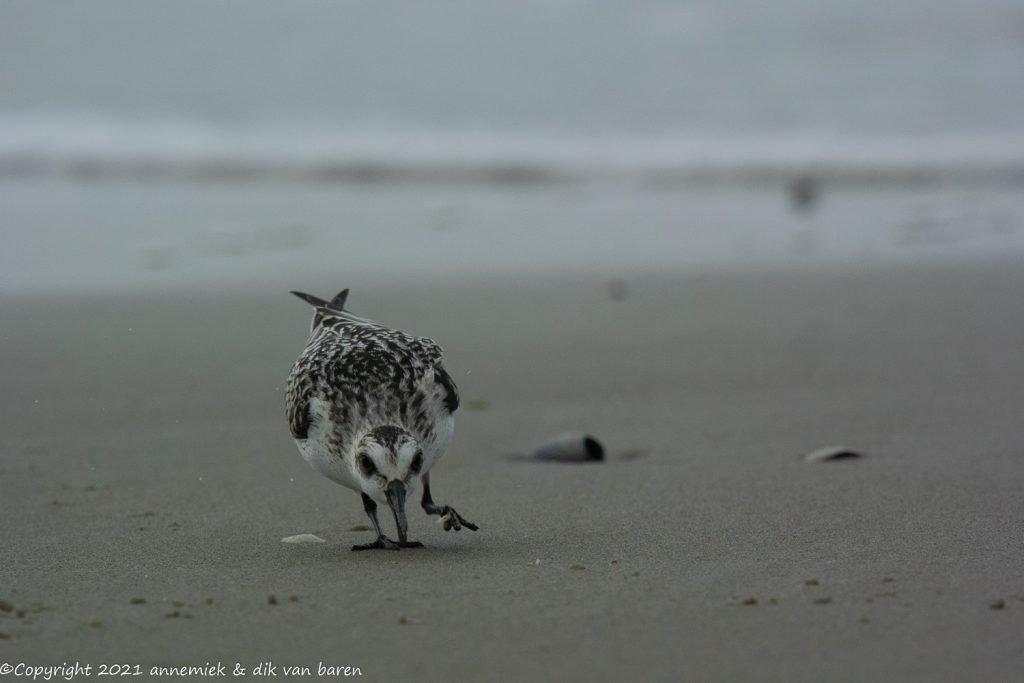
Foto at top: Holland Sanderling (Drieteenstrandloper) 10 meter windy dark cloudy wheather handheld V3 Nikkor 300mm f/4E PF VR equivalent 810mm (2.7 x 300) standard camouflage. This picture has been “soft cropped”, cut out the RAW original file (shown below), thereafter edited in Adobe Lightroom software and “soft cropped”.
“Soft cropping” using software like Adobe Lightroom
Extra info: “to crop” in Dutch means “afsnijden, oogsten”.
Look at the picture of the Sanderling at the top of this page. We have cut a piece out of the original digital file using appication Adobe Lightroom. We call this operation “soft cropping“. We like to emphasize the difference with “hard cropping” which always is performed by hardware. The original unedited RAW picture of the Sanderling is shown here below. You can see more and interesting examples of soft cropping at: 7 Post production.
“Hard cropping” vs “soft cropping”, sensor formats, crop factors and image area modes in camera’s
In digital photography two essentially different methods of “cropping” exist.
- Soft cropping (“kaderen”) is done by you when you are “cutting” a part out of a digital picture using image editing software like in the example above. “Soft cropping” is not an official name but we use it to emphasize the essential difference between soft and hard cropping.
Hard cropping is accomplished in one of two ways:
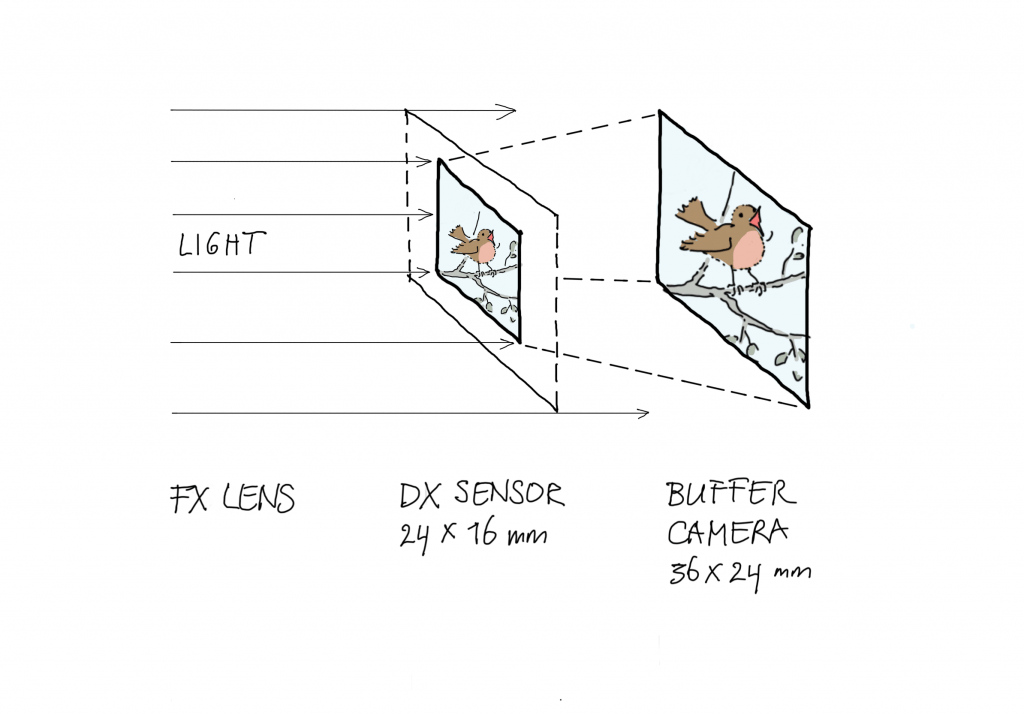
- 1 The digital camera crops a piece out of the full image: Many digital camera’s are built around a so called full frame image sensor (36 x 24 mm) for example Nikon DSLR’s D700, D800, D500, D750 and Nikon MLC’s Z5, Z6, Z6 II, Z7, Z7 II, Z8, Z9. However camwea’s like for example D500 and Z50 are built around a so called APS-C type sensor which is significantly smaller: 24 x 16 mm. An APS-C Type camera like the D500 automatically and irreversably hard crops, “cuts”, a piece out of the full frame lightbeam of an “FX lens” – as Nikon calls this type of lends – when you use a classical full frame lens, stores this in its data buffer and displays it on its image screen, just like that.
- 2 You intentionally switch the digital camera via its menu into one of camera’s secondary image area modes (beeldformaten) as a result of which the camera, irreversably, “cuts” a smaller piece out of the image sensor area and transfers this smaller piece of the full digital image into its data buffer and displays this on the image screen.
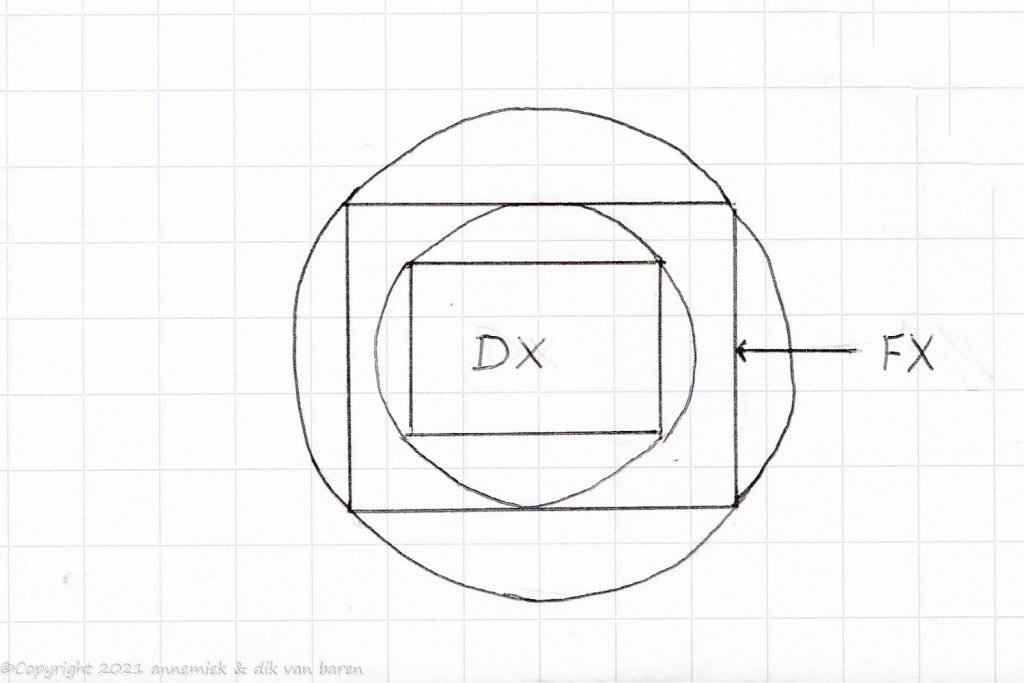
- Full frame Nikon D800[E] 36 Mpixels (7360 x 4920 pixels) switched into DX Mode (24 x 16mm) (4800 x 3200 pixels) and then using crop factor 1.5.
A hard crop happens for example when using:
- APS-C type camera Nikon D500 21 Mpixels (24 x 16mm) (5568 x 3712 pixels) standard crop factor 1.5 but also switched for example into its 1.3 mode (18 x 16mm) ( 4272 x 2848): crop factor 2.0.
- Panasonic four thirds type 16 Mpixels G3 (for example behind telescope): (standard crop factor 2.0) in 8Mb mode (crop factor 4) or 4Mb mode (crop factor 8).
Hard cropping a full frame lens lightbeam by an APS-C type camera
So, when you use a full frame lens on a digital camera with an APS-C type image sensor like a Nikon D300, D7200, D500 or Z50, the camera will only “see” and “hard crop” a part out of the full frame lightbeam projected by the full frame lens into this camera. It just happens that way.
Bird photographers welcome hard dropping because it feels like a lens suddenly has larger focus distance. Marketeers like to call this phenomenon “focus enlargement”. A 300mm lens used on a D300 “miraculously” behaves like a 450mm lens! How wonderful! This was of course good news especially for bird photographers. The confusion started when the first grown up digital camera’s like Nikon D300 appeared on the market featuring a rather relatively image sensor and still using lenses that projected a classical full frame (kleinbeeld film) 36 x 24mm image lightbeam onto the smal 24 x 16 mm image sensor of the camera. This type of sensor was originally called “APS-C type sensor“, wherever that stems from.
Crop factor and 35mm equivalent
A full frame sensor has surface 36 x 24 mm, an APS-C sensor surface 24 x 16 mm. The so called “crop factor” of the camera is the value of the quotient of these two sensor surfaces. The well known crop factor of DX camera’s like Nikon D300, D7200, D500 or Z50 is 36 x 16 / 24 x 16 = 1.5. A Nikkor 300mm lens behaves like a 300mm lens at a Nikon Z7 II but as a 450mm lens at a Nikon Z50. A full frame camera has “crop factor” value 1.0. So this hard cropping results in an “artificial” magnification factor 1.5 in case of a D500 or any other APS-C type digital camera like a D7200 or a Z50. The cause of this “extra magnification” is the so called “crop factor“.
This “35mm equivalent” or “equivalent” can be regarded as the “total focus distance of a combination” of a digital camera-lens-converter. A lens, like a loupe, produces a magnified image of an object. The amount of magnification is linearly proportional to the focus distance of this loupe. In classical small film photography using 35 millimeter film negatives and positives, the focus distance of (tele)lenses has always determined the magnification of these lenses. Basically the optical magnification of a lens is linearly proportional to its focus distance in millimeters, so the optical magnification of a camera-lens-converter-combination will be linearly proportional to the 35mm equivalent:
35mm equivalent (mm) = focus distance lens (mm) x converter factor (if converter used) x crop factor camera.
Mind you: Only if the image sensor of a camera has sufficient resolution (a large number of pixels per square millimeter) the “extra magnification” caused by this hard cropping can be “realised” preserving satisfactory image quality whith the implied lower resolution caused by the “stretching” process of the digital mage through hard cropping.
When talking about reach (bereik) in bird photography, the amount of detail of the surface in the digital picture of a bird at a certain distance, will be squarely proportional to the 35mm equivalent because length and width of the bird (surface) will both be magnifed to the same extent. So reach (bereik) of a combination is squarely proportional to the 35-mm equivalent of a combination. This is used at page Reach.
Nikon full frame camera’s like D800, D750, Z5, Z6 II and Z7 II can operate either in so called FX mode (full frame mode, 36 x 24mm) or DX mode (APS-C mode, 24 x 16mm) and often in some extra “image area modes“, all implemented as extra hard crop modes. Particularly video modes may be hard cropped to accomplish higher FPS rates.
And this, by the way, is also the reason why bird and sport photographers hoped that Nikon would develop at least one APS-C type Z mirrorless like the Z50. The combination of high image quality and crop factor 1.5 makes an APS-C sensor type camera quite suitable for sports, wildlife and bird photographers because soccer players, tennis players, athletes, lions, elephants, birds and the like are often far away and wildlife, bird and sports photographers often carry lots of stuff like camouflage, tripods, binoculars, camera’s, heavy lenses, converters, bird guides, coffee, sandwiches, backpacks, etcetera so they prefer to carry lightweight lenses if by any means possible.
Fistrule: Try to remenber this: APS-C Type camera, “hard crops”out of full frame light beam an 1/1.5 = 4/9 full frame image because 16 x 24 / 24 x 36 = 4/9). For example Z7 II of 46Mp produces 4/9 x 46 Mp = 21 Mp “APS-C normalised” images and will have about same reach as APS-C type Z50 21 Megapixels. Also this fistrule will be used at page Reach this blog.
| Nikon DSLR full fame sensor D800 | 1.0 |
| Nikon DSLR APS-C sensor D300 D7200 D500 | 1.5 |
| Panasonic four thirds sensor MLC LX3 G1 G3 | 2.0 |
| Nikon System 1 CX sensor MLC V1 V3 J5 | 2.7 |
| Nikon MLC full frame sensor Z7 | 1.0 |
| Nikon Z Series MLC APS-C sensor Z50 | 1.5 |
| 35mm equivalent D500 Nikkor 500mm f/5.6E PF VR TC-14E=500 x 1.4 x 1.5=1050mm | APS-C sensor |
| 35mm equivalent D500 Sigma Sport 150-600mm f/5.0-6.3 TC 1401=600 x 1.4 x 1.5=1260mm | APS-C sensor |
| 35mm equivalent D500 G2 Tamron 150-600mm f/5.0-6.3 TC X14=600 x 1.4 x 1.5=1260mm | APS-C sensor |
| 35mm equivalent Z50 Nikkor 500mm f/5.6E PF VR TC-20E III=500 x 2.0 x 1.5=1500mm (!) | APS-C sensor |
| 35mm equivalent D7200 Nikkor 300mm f/4E PF VR TC-14E=300 x 1.4 x 1.5=630mm | APS-C sensor |
| 35mm equivalent V3 Nikkor 300mm f/4E PF VR TC-14E=300 x 1.4 x 2.7=1350mm | CX sensor |
| 35mm equivalent Swarovski 50X + V1 1 Nikkor 18.5mm f/1.7=925 x 2.7=2700mm (!) | CX sensor |
| 35mm equivalent Nikon ED82 30X + Panasonic G3 Lumix 20mm f/1.7=600 x 2.0 = 1200mm | Four Thirds sensor |

Pingback: 4 Camera’s Light – LIGHTWEIGHT BIRD PHOTOGRAPHY